
Ultimate Muscle Pump Supplement for Max Growth
May 2, 2026
You know the feeling. Midway through a hard push day, your sleeves tighten, veins come up, and the target muscle finally feels like it’s doing the work instead of your joints. Most lifters stop there and call it a good pump.
That’s too shallow.
A muscle pump supplement matters when it improves the quality of the session, not when it gives you a mirror moment. Better blood flow and better muscle cell hydration can help you train harder, sustain output longer, and create a better environment for the supplements that move the needle, especially pre-workout formulas and creatine. If you care about strength and hypertrophy, that’s the frame you should use.
What Is a Muscle Pump and Why It Matters for Your Pre-Workout
A pump is the combination of blood and fluid building up in the working muscle while you train. You feel it as tightness, pressure, fullness, and better connection to the muscle you’re trying to hit. On chest day, it can make pressing feel smoother and pec contractions easier to hold. On arm day, it can turn random reps into deliberate work.
Most lifters treat that as cosmetic. Serious lifters shouldn’t.
A good pump tells you blood is getting where it needs to go. That matters because training performance depends on delivery. Oxygen has to get in. Nutrients have to get in. Waste byproducts have to clear. If your pre-workout includes focus ingredients, endurance support, and pump actives, the whole point is to create a session where output stays high and the target muscle keeps working.
A pump is a performance signal
Think about the sessions where you feel flat. Warm-up sets drag. Contractions feel dull. The muscle never seems to “switch on.” That usually doesn’t feel like your best training because it isn’t.
When the pump is there, the workout often runs better. You get better exercise feel, steadier rep quality, and a stronger mind-muscle connection. That doesn’t mean a pump alone builds tissue. It means the session has the ingredients to be more productive.
Coach’s take: Stop judging a pump by how you look between sets. Judge it by whether it helps you keep tension where you want it and maintain training quality.
Why this matters inside a pre-workout stack
Pump support shouldn’t be a random extra tacked onto a label. It should work alongside the rest of your pre-workout formula and your daily creatine use.
That’s the part most marketing misses. Better blood flow and fuller muscle cells can make a hard session feel more stable and repeatable. For a lifter chasing size and strength, that’s the core value. The pump isn’t the goal. The better session is.
The Science of Pump How Pre-Workout Ingredients Boost Blood Flow
There are two main ways a muscle pump supplement works. One widens the pipes. The other fills the muscle cell.
That’s the cleanest way to understand it.
Nitric oxide widens the highway
Your blood vessels are like highways feeding the working muscle. When traffic increases during training, narrow lanes become a problem. Nitric oxide helps relax and widen those vessels so more blood can move through.
That widening is called vasodilation. In practical terms, it means more delivery to the muscle during the session. More blood flow doesn’t guarantee a stronger one-rep max that day, but it can support endurance, work quality, and the feeling that the target muscle is fully online.
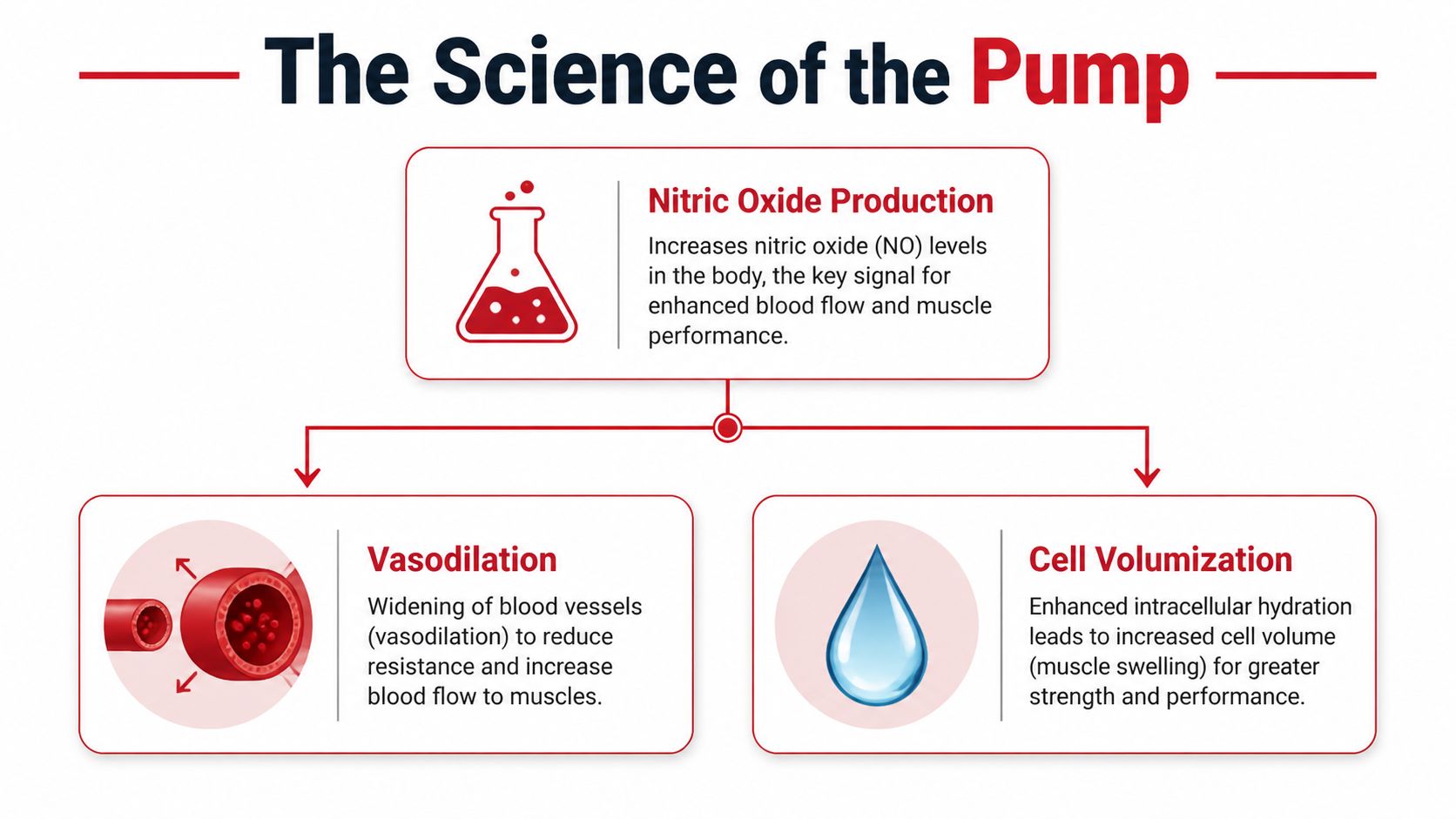
The ingredients that drive this pathway are usually nitric oxide precursors. Their job is simple. Increase the conditions that support better blood flow while you train.
Cell volumization fills the muscle from the inside
The second pathway feels different. Instead of mainly widening blood vessels, ingredients such as glycerol help pull water into muscle cells. That creates a fuller, rounder, denser feel. The look is part of it, but the training effect matters more.
A hydrated muscle generally performs better than a flat one. If your cells are better hydrated, contractions often feel more stable and repeat efforts can feel less sloppy. This is why some pump formulas don’t rely only on nitric oxide support. They also attack hydration.
Blood flow and cell hydration are not the same thing. The best pump formulas know that and cover both.
Why your pre-workout should care about both
A lot of lifters make the mistake of separating “pump products” from “performance products.” That split doesn’t make much sense. If your pre-workout gives you energy and focus but your muscles still feel flat and disconnected, the formula is incomplete.
A stronger setup usually includes:
- Nitric oxide support: To improve blood flow during training.
- Hydration support: To help the muscle stay full and responsive.
- Performance support: To keep output high once the session gets hard.
What this means in the gym
On paper, this sounds technical. Under the bar, it’s simple.
You want a product that helps you:
- feel the target muscle early in the workout,
- maintain that feel as fatigue rises,
- keep reps clean during higher-volume work,
- leave the gym feeling trained, not just stimulated.
That’s why pump ingredients belong in a serious pre-workout conversation. They aren’t there for vanity. They help shape the training environment.
Decoding the Label Key Pump Ingredients in Your Pre-Workout
You hit your caffeine, your focus is locked in, and the session still feels flat by set three. That usually means the label is built for hype, not training. A real pump formula supports blood flow and cell volume well enough to make the rest of your stack work better, especially your pre-workout performance ingredients and daily creatine.
Read labels like a coach, not a customer.
L-Citrulline should be near the top of the formula
For most serious lifters, L-Citrulline is the first pump ingredient worth checking. It raises arginine levels more effectively than oral arginine in many practical pre-workout setups, which is why experienced formulators keep coming back to it.
The useful range is broad, but the label still has to be honest. If a product gives you a small token dose, do not expect much from it. A stronger formula uses enough citrulline to matter and builds the rest of the profile around it.
Citrulline also fits the bigger performance picture. Better blood flow can improve training quality during higher-volume work, and that makes it a strong partner for creatine, carbs, electrolytes, and the other ingredients that move strength and hypertrophy forward.
Nitrosigine earns respect if the dose is there
Nitrosigine® is one of the few trademarked pump ingredients I take seriously. The appeal is not branding. The appeal is that it has human research behind it and is commonly included at 1.5 g per serving, a studied amount linked to nitric oxide support in published ingredient research from Nutrition21 on Nitrosigine.
Some research on the ingredient also reports blood flow effects lasting for up to six hours, which makes it more useful than a quick cosmetic pump for long sessions or dense hypertrophy training, as summarized by Nitrosigine ingredient science.
That matters if your pre-workout is part of a full stack. Longer-lasting blood flow support can help your session stay productive after the early stimulant buzz fades.
Glycerol fills the muscle through hydration
Glycerol works differently from nitric oxide boosters. Its main job is helping pull water into the muscle cell, which changes how the muscle feels during training and how full it looks under load.
That makes glycerol a smart add-on for bodybuilders, pump-focused hypertrophy blocks, and anyone who wants more stable output across long sessions. It also exposes sloppy habits fast. If your fluid intake is poor, glycerol will not save the workout.
Some pre-workouts pair glycerol with endurance ingredients. If you are sorting through those labels and want to understand the tingling side effect, this breakdown of why beta-alanine can make you itchy explains it clearly.
Clinically Dosed Muscle Pump Ingredients
| Ingredient | Mechanism | Clinical Dose | Primary Benefit |
|---|---|---|---|
| L-Citrulline | Nitric oxide support through improved bioavailability | Clearly disclosed, performance-relevant dose | Increased blood flow and better training support |
| Nitrosigine® | Sustained nitric oxide support and blood flow elevation | 1.5g | Longer-lasting pump support and nitric oxide support |
| Vegetable glycerol | Hyperhydration and cell volumization | 10g | Fuller muscles through intracellular hydration |
A strong label is transparent. It shows the ingredient, the full dose, and the reason it belongs in the formula. If the product hides behind a proprietary blend, move on.
Optimal Dosing and Timing for Maximum Pump
You hit your first working set and everything feels flat. No fullness, no pressure, no pop. In most cases, the problem is not the formula. It is poor timing, poor hydration, or both.
A pump supplement only does its job if you set up the session correctly. For serious lifters, that matters because better blood flow and cell hydration can make the rest of your stack work better. Your pre-workout feels sharper. Your work sets feel more connected. Your daily creatine monohydrate support has a better training environment to contribute to over time.
Time it before you lift, not after the session has started
Take your pump-focused pre-workout early enough that absorption is underway before your first hard sets. If you wait until warm-ups are over or sip it halfway through the session, you blunt the whole point.
You do not need a stopwatch obsession. You need a repeatable routine.
Train at roughly the same time. Eat your pre-training meal at a similar interval. Take your pre-workout in the same pre-lift window. That consistency lets you judge what improves performance instead of guessing based on a random good day.
A few rules matter more than everything else:
- Show up hydrated. One shaker in the parking lot does not fix a full day of low fluid intake.
- Keep the routine stable. Meal timing, pre-workout timing, and warm-up structure should stay consistent.
- Match the setup to the training day. Pump-focused formulas make more sense on higher-volume hypertrophy sessions than on low-volume maximal strength work.
Glycerol only works if you respect fluid intake
Lifters often make mistakes here.
If you want the cell volumizing effect of glycerol, you have to take the water side seriously. 10g of vegetable glycerol can support hyperhydration-driven muscle fullness, but it requires up to 1.5x normal fluid intake to do it properly, as explained in this breakdown of glycerol-based hyperhydration.
That changes how you should use a glycerol-heavy formula. You are not just taking a scoop. You are setting up hydration so the ingredient can pull water where you want it.
Practical rule: If your urine is dark, your bodyweight is down from the morning, and you have barely had fluids all day, expect a weaker result from a glycerol-heavy muscle pump supplement.
This walkthrough is worth watching if you want a visual breakdown of pre-training setup and pump-focused use:
A simple protocol that works
Keep the process repeatable:
- Start hydrating earlier in the day. Do not wait until you get to the gym.
- Take your pre-workout before training starts. Give the ingredients time to work before the first hard set.
- Increase water intake if glycerol is included. That is part of using the ingredient correctly.
- Train for a pump if you want a pump. Controlled eccentrics, enough volume, and shorter rest periods on accessory work all improve the result.
The best approach is the one you can repeat every week and tie directly to better work sets.
The Ultimate Stack How Pump Enhances Pre-Workouts and Creatine
A pump formula on its own is optional. A pump formula inside a smart stack is where it becomes useful.
That stack starts with pre-workout for energy, focus, and training drive. It stays grounded with creatine for repeated high-output performance and long-term progress. Pump ingredients sit between them and make the session feel more effective by improving blood flow and muscle fullness.
Why pump ingredients belong in a real stack
A good stack does three jobs at once.
First, the pre-workout helps you show up ready to train with intent. Second, creatine supports hard efforts over time. Third, pump ingredients help create a training environment where the session feels connected instead of flat.
That’s why I don’t like treating pump formulas as novelty products. Used correctly, they can complement the rest of your stack. Better blood flow can help the workout feel smoother. Better cell hydration can make muscles feel more responsive. Combined with a properly built pre-workout, that can improve the quality of your work sets.
You don’t need to choose between a hard-hitting pre-workout and a muscle pump supplement. For many lifters, the best answer is a formula or stack that respects both.
How to build it without overcomplicating it
Keep the system straightforward:
- Base layer: Daily creatine. If you don’t already use it, start with a plain creatine monohydrate product and stay consistent.
- Session layer: A pre-workout that covers energy, focus, and endurance support.
- Pump layer: Citrulline, Nitrosigine, glycerol, or a combination, depending on how you train and how much fullness you want.
This matters most for hypertrophy blocks, bodybuilding sessions, and any training phase with enough volume to benefit from stronger blood flow and a better muscle feel. It also works for late-day trainees who want non-stim pump support without loading up on more caffeine.
The blunt recommendation
If your budget is limited, buy creatine first. It’s still the foundation.
After that, choose a pre-workout that doesn’t ignore pump ingredients. A formula that gives you energy but leaves you flat halfway through the workout is incomplete. If you already use a strong pre-workout and still want more fullness, layer in a dedicated pump product or add a pump-focused session formula on your hypertrophy days.
That’s the hierarchy. Creatine first. Pre-workout second. Pump support as the multiplier that upgrades the session.
A Lifters Checklist for Choosing an Effective Pump Formula
You can spot a weak pump formula before you ever train with it. Read the label for 30 seconds. If the doses are hidden, the ingredient list is bloated, or the formula looks built for marketing instead of performance, put it back.
A good pump product should do one job well. It should improve blood flow, help you stay fuller through hard volume, and fit cleanly into the pre-workout and creatine setup you already use. If it cannot do that on paper, it will not do it in the gym.
What to look for on the label
Use this checklist before you buy:
- Transparent dosing: Every key ingredient should list an exact amount. If the label hides behind a proprietary blend, you cannot tell whether the formula is effective or underdosed.
- Citrulline at a useful dose: Look for L-citrulline in a meaningful range. Many effective formulas land between 2g and 8g per serving (citrulline research overview). Higher-output pump products usually push toward the upper end.
- Arginine treated realistically: L-arginine often looks good in ads but performs worse in practice because oral bioavailability is poor. Trials using 3g acute doses have not shown the same consistency lifters get from citrulline (citrulline research overview).
- A clear purpose for each ingredient: Citrulline or Nitrosigine for nitric oxide support. Glycerol for hydration and fullness. Taurine for cell hydration and performance support. Every ingredient needs a reason to be there.
- A formula that fits your training: Late session lifter? Go stim-free. Training earlier and want one all-in-one product? Use a pre-workout that covers energy, focus, and pump support without shortchanging any of them.
If you train later in the day or want to cut back on stimulants, this guide to a pre-workout alternative for different training schedules is worth reading.
What usually signals a weak formula
Bad pump products follow the same pattern.
- Proprietary blends: Hidden doses protect the brand, not you.
- Ingredient stuffing: Ten flashy ingredients at pixie-dust amounts still equal a weak formula.
- Hype-first copy: If the sales page screams about skin-splitting pumps but the label stays vague, the product is built to sell, not perform.
- No hydration instructions: Glycerol can work well, but only if water intake is obvious and practical.
- No stack logic: A serious pump formula should make sense next to your pre-workout and creatine. If it duplicates random ingredients without enough dosing to matter, it is dead weight.
The best choice is rarely the product with the loudest branding. Buy the one with disclosed doses, ingredients that complement each other, and a role inside your full training stack. That is how a pump supplement stops being a novelty and starts improving the quality of your work sets.
Beyond the Pump The Link Between Blood Flow and Hypertrophy
You feel it halfway through a hard hypertrophy session. The target muscle stays full, reps stay cleaner, and the last few work sets do not fall apart as fast. That matters. A good pump is not just a cosmetic payoff. It can improve the quality of the training that drives growth.
Serious lifters should view pump support as a performance multiplier inside a full stack, not as a standalone trick. More blood flow and better cell volumization can make your pre-workout more useful in the session and give creatine-fed muscle a better environment to perform hard, repeated contractions.
What a pump actually contributes
Hypertrophy still runs on the basics. Mechanical tension, enough hard sets, progressive overload, calories, protein, sleep, and creatine do the heavy lifting.
Pump ingredients help in a different way. They can improve muscle fullness during training, support blood flow to working tissue, and make it easier to keep tension where you want it. For a bodybuilder or physique-focused lifter, that has real value. Better execution usually means better stimulus.
Cell swelling matters here too. A fuller muscle often feels more stable and responsive under load. That does not replace progressive training. It helps you get more out of it.
Treat the pump as a tool that improves work sets, not as the reason muscle grows.
What the evidence supports
A practical assessment is simple. Nitric oxide support may contribute a modest edge for hypertrophy when paired with resistance training, but the effect is small compared with the fundamentals. A 2025 meta-analysis on nitric oxide boosters reported +1-2% lean mass over 8 weeks when combined with resistance training, according to this discussion of NO boosters and long-term growth.
That is useful context because it kills the marketing nonsense. Pump products can help. They do not deserve top billing in your plan.
Creatine does. Consistent programming does. Hitting food targets does.
My coaching take
Use a muscle pump supplement if it helps you train harder with better execution across your volume work. Keep it in the stack with a properly dosed pre-workout and daily creatine, where improved blood flow and cell hydration can support performance that lasts beyond the first 20 minutes of the session.
If the product helps you hold output, feel target muscles sooner, and keep set quality high, keep it. If you are chasing a skin-tight feeling while your training plan is sloppy and your creatine use is inconsistent, you are paying for a sensation, not results.
Muscle Pump Supplement FAQs
Are pump supplements safe and are there side effects to watch for?
Most lifters tolerate pump-focused formulas well when they follow the label and stay hydrated. The most common issues are practical ones, not dramatic ones. Bloating, stomach discomfort, or feeling “too full” can happen, especially if the formula leans hard on glycerol and you slam it without enough fluid or too close to training.
Start with the lower end of your tolerance if the formula is new to you. Then assess how you perform, how your stomach feels, and whether the pump helps the session.
Can I take a pump supplement with a stimulant-based pre-workout?
Yes, if the ingredients don’t overlap in a reckless way and your caffeine tolerance is under control. This is a common setup for lifters who want the energy and focus from a traditional pre-workout plus extra blood flow and fullness from a dedicated pump product.
Read both labels. Don’t stack blindly. If both products share several active ingredients, more isn’t automatically better.
Should I use pump supplements on rest days?
Usually no. For most lifters, a muscle pump supplement is a training tool, not a daily essential. Save it for sessions where blood flow, endurance feel, and cell volumization will improve performance.
The exception is if you’re using part of a broader non-stim pre-workout routine for a specific reason, such as practice, sport work, or a second session later in the day.
How long does it take to feel the effects of a pump supplement?
It depends on the formula, your meal timing, your hydration, and the session itself. Some ingredients hit more through blood flow during the workout. Others, like glycerol-based products, are heavily influenced by water intake and how you train.
If you want the effect, earn it in the gym. Pump formulas work best when your training style gives them something to amplify.
Is a pump supplement better than creatine?
No. Different job.
If you’re building from scratch, prioritize creatine first. Then add a pre-workout that fits your schedule and tolerance. Add a muscle pump supplement when you want to sharpen session quality, especially on hypertrophy-focused days.
If you want supplements built for lifters who care about real dosing instead of label theater, take a look at Eternal Supplements. Their lineup centers on serious pre-workouts and foundational staples like creatine, which is exactly where most dedicated lifters should focus first.